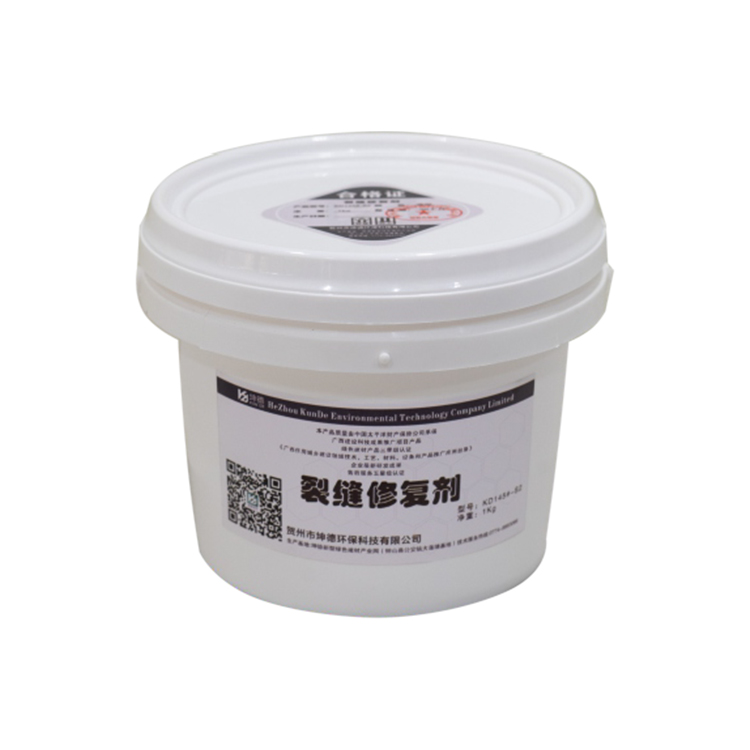
The following is the construction procedure for the crack repair agent (Component B of crack repair mortar), organized in the original order.
1. Base Layer Pretreatment
(1) Locate cracks:Find the exact location of the cracked membrane (you can observe the leak point on rainy days, or conduct a water splash test when the surface is dry), and mark the crack range (including the 5-10cm surrounding area).
(2) Remove debris:Use a wire brush or sandpaper to grind the surface of the crack and surrounding membrane, remove dust, moss, aging layers and loose particles; if there is oil stain, wipe it clean with alcohol or special detergent.
(3) Dry the base layer:Use cold air from a blower to dry the moisture inside the cracks (critical! Moisture will cause the repair agent to lose its bonding effect); if the base layer (such as the cement mortar layer under the membrane) seeps water, you must first plug the leak point of the base layer (you can inject cement-based capillary crystalline repair agent).
2. Material Preparation Method
No material preparation is required, it can be used directly.
3. Construction Method
(1) Minor cracks (≤3mm):Squeeze and inject Component B of crack repair mortar along the direction of the crack to ensure the crack is fully filled (you can use a scraper or wear gloves to press Component B of crack repair mortar into the crack, with the surface slightly higher than the membrane plane). Wait until the first coat of repair mortar is semi-cured (about 2~4 hours), then apply another layer of Component B of crack repair mortar within 5cm on both sides of the crack to form a "widened sealing band" and improve crack resistance.
(2) Larger cracks (3~10mm) or with minor membrane delamination:First use a utility knife to gently lift the membrane at the edge of the crack (avoid expanding the damage), inject repair mortar Component B into the crack to ensure the deep part is fully filled. Scrape off the excess repair agent on the surface with a scraper, then paste a layer of crack-resistant mesh fabric on the crack surface (width 5cm larger than the crack), then apply a layer of Component B of crack repair mortar on the mesh fabric to completely cover the mesh, compact it and drive out air bubbles.
4. Coverage Rate
It depends on the length and depth of the gap to be filled.
5. Drying Time
About 24 hours. The next construction process can only be carried out after it is completely dry.
6. Color After Construction
Transparent.
7. Acceptance Inspection
Wait for it to dry completely according to the repair agent instructions (about 24-48 hours). During this period, avoid stepping on it and exposing it to rain (you can cover it with a plastic film for protection). Conduct a water splash test after curing: splash water on the repaired area, observe for 24 hours to check if there is still leakage. If there is no leakage, the repair is successful.
8. Precautions
(1) If the membrane is overall aged (such as embrittlement, slag falling off), it is difficult to completely solve the problem only by using Component B of crack repair mortar. It is recommended to partially cut off the aged area, re-lay new membrane, and seal the joints with repair mortar.
(2) When the temperature is below 5℃ or above 35℃, the drying time of Component B of crack repair mortar will be too slow or too fast. You need to speed up the operation, and it is recommended to construct in the early morning or evening; if the crack is caused by base layer settlement (such as roof structural deformation), you need to add expansion joints at the base layer position corresponding to the crack after repair to avoid re-cracking.